

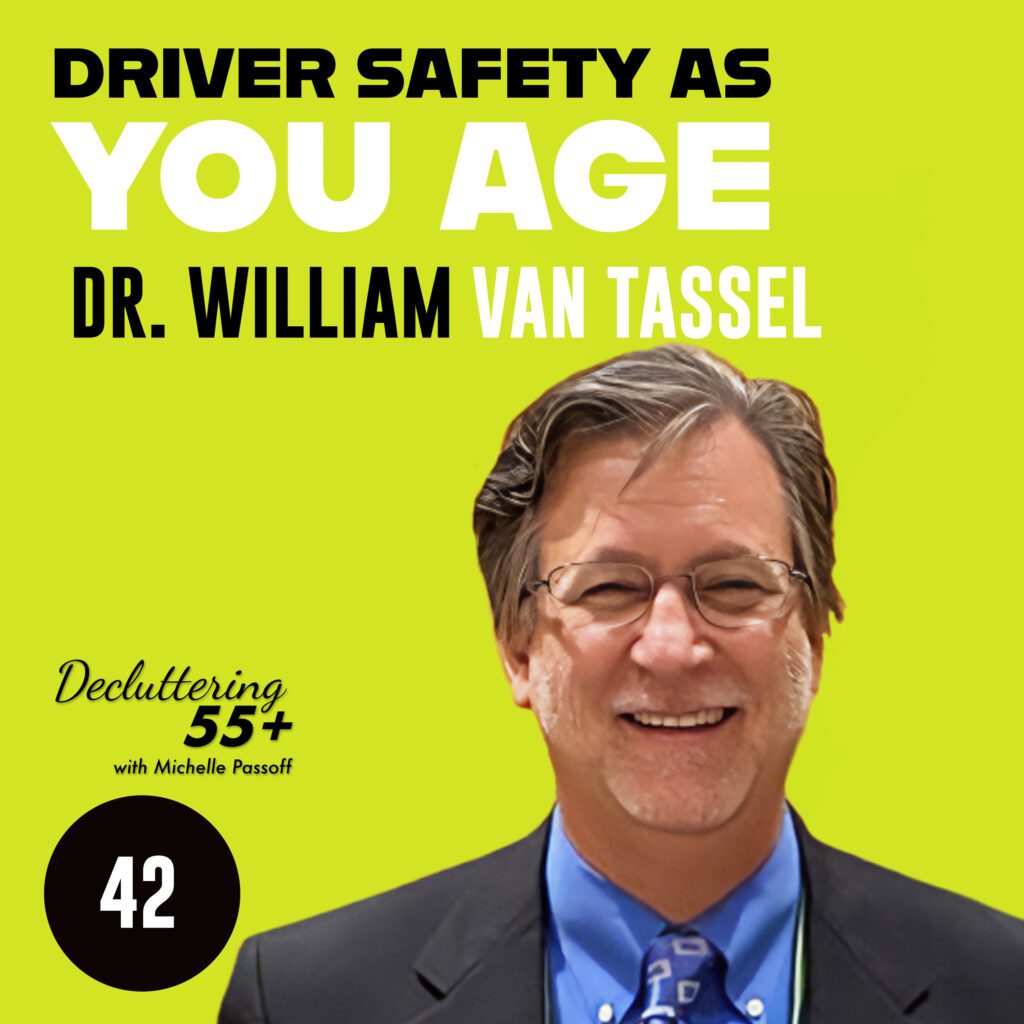
EP.42

Driver Safety As You Age with Dr William Van Tassel

Driving safety is very important to seniors, not because they cannot necessarily get around if they don't drive, but more from a sense of maintaining one's independence.

Summary

Dr. William Van Tassel, manager of AAA’s driver training program, joins us to talk about the importance of driving safety as we age. With expert insights and practical tips, he helps older adults navigate the challenges of staying safe and independent behind the wheel. This important conversation is a must-watch for anyone looking to drive smart and stay active for years to come.

Picture of Michelle Passoff

Michelle Passoff

Host of the Decluttering 55+ podcast and author of LIGHTEN UP: Free Yourself from Clutter.

More Posts

Ep42

Driver Safety As You Age with Dr William Van Tassel

05/02/2025  - Podcast Transcript

Drivers Safety as you Age with Will

Michelle (00:30)

Welcome once again to Decluttering 55 Plus with Michelle Passoff, the place to come to hear authors, experts, authorities, and geeks talk about next level clutter. Yes, we like to talk about letting go of papers, clothes, and other stuff. That’s conventional clutter, and here we talk about that in an unconventional way, not only as a path of being neat and tidy, but as a little known and underused way to make space to reach life goals.

But moreover, it’s here that we break new ground. We talk about next level clutter, specifically for baby boomers and those who love them. Next level clutter.

are areas of life that are baffling or confronting, so we have a tendency to sweep them under the carpet, put them off another day or forever. Instead, we intend to bring those areas of life out into the light of day so we can learn new things, get in action, and get things done. Our objective is to invigorate our lives and leave a legacy, not a mess. What are those next level clutter areas, you ask? Well, resetting health, fitness, and eating regimens, digital decluttering,

preparing your side of your life story, healing, letting go and creating relationships, deciding where to live and what to do next in life, getting your financial and legal papers in order, and even pre-planning your funeral. When we think of your health and fitness as we age, driver safety may not be the first thing that comes to mind.

But indeed, along with aging, comes some issues that make baby boomers particularly vulnerable to accidents and fatalities on the road. And we want to talk about that with our guests today so that we can be more safe and we can be more responsible for the safety of others. And at the same time, we can continue to remain active. So allow me to introduce you to Dr. William Van Tassel.

He manages the Automobile Association of America’s driving training program, providing safety education, resources, and expertise from coast to coast. Thank you for being here, Dr. Van Tassel.

William (02:40)

I’m Michelle, it’s great to be with you.

Michelle (02:42)

Before we delve into everything we need to know about driver safety as we age, how did you get into this business? It’s such an unusual niche that you have.

William (02:54)

Michelle I came to this from a little bit different path that a lot of people in the field a lot of people come from psychology Side of things, but I actually came from the area of performance driving Somehow I convinced my parents from a high school for a graduation gift to send me to a high-performance driving school in California and then I started competing and low-speed and high-speed driving skill competitions with sports cars

and ⁓ was nationally competitive and then eventually started wondering, can some of these same skills actually be useful on the street? How to brake well, how to control your car, where to look, how to steer. It turns out that there is a case for that. So I started studying more deeply that earned a doctorate along the way and then joined AAA as its driving safety expert.

Michelle (03:49)

Wow, that’s fantastic because I for one am afraid of all those thrill seekers on the road. ⁓ So we could always use more safe drivers, that’s for sure. What are the most common safety challenges faced by baby boomers as they age?

William (04:06)

Well, driving safety is very important to seniors, not because they cannot necessarily get around if they don’t drive, but more from a sense of maintaining one’s independence. If they cannot drive safely, though, they won’t be allowed to continue to drive. Yeah. So one aspect, one perspective that we’re promoting is ⁓ it’s probably better to view focus on remaining mobile.

throughout your lifetime rather than only relying on driving during your entire life. Fortunately, we’ve got more options than ever before for getting where you want to go, when you want to go there. Some good news is that we’re living longer today. That’s actually great news. The challenge that comes with that is we’re likely to outlive our ability to drive safely just because of natural age-based changes.

Michelle (04:53)

Yeah.

William (05:03)

we’re likely to outlive our ability to drive safely by seven to 10 years. ⁓ So instead of just relying only on driving and having a driver’s license to get around, it’s probably better to view with overall mobility.

Michelle (05:07)

Well.

Well, how do you assess whether your driving skills are still safe?

William (05:22)

⁓ Well, there’s a lot of options there in terms of how to get a sense of that if you will and It’s a great idea to have your to self assess or assess your driving schools You can get a good baseline if nothing else for where your skills are right now. So there’s at least Three areas or ways you could do that first is pretty simple and straightforward a pen and paper test something you can access online very cheaply

quickly. In fact, I don’t know of any of those that charge anything. So it’s free and very private. So with answering a few questions, you can get a sense of where you are in terms of driving skills. Now the next step beyond that. Yes, go ahead.

Michelle (06:09)

No, no, go ahead, finish ⁓ the next step.

William (06:14)

The next step would be for a driving assessment, and then a step even beyond that would be a driving evaluation, and then a third step would be a clinical driving assessment.

Michelle (06:27)

Now there’s advantages to that on your insurance if you take those tests and where do you find those tests?

William (06:35)

The test online can be a whole bunch of organizations have them. Ours you can find, AAAs you can find on the AAA exchange website, AAA exchange website. What you’re looking for is something called Drivers 65 Plus. Drivers 65 Plus has just a handful of questions and it is based on research and can give you a very quick idea of how you’re doing. The driving skills evaluation, that’s

more complex, that actually is a test of your abilities in the car as well as outside the car offered typically by driving schools identifies any weaknesses you might have. They may recommend, for example, some additional training in car to help you further ⁓ reduce your risk or maybe move to the next step. They might recommend you having a clinical driving assessment and that’s done by specialists.

that are more medically trained. They have a greater understanding of the progressive medical conditions and life changes that can affect driving. Those involve a deeper dive into the medical history. Yeah. assessments and in-car. So it’s more complicated. There’s usually a cost there. Sometimes there are insurance benefits to that. More commonly where we see insurance involved is where the driver takes a driving refresher course.

Michelle (07:47)

card.

That’s a good idea. I can remember when I was in high school and I did my driving course. I had such a good teacher, I can remember it to this day, you can imagine. ⁓ what are you, when should you, what’s your red flag? What’s the red flag that tells you now is my time to assess if I’m safe and others are safe if I keep driving?

William (08:28)

Well, hopefully nobody gets to the red flag point. Hopefully they start that on their own. They self initiate these assessments and evaluations to get started.

Michelle (08:37)

It’s

more based on age, like when you get to a certain age it’s time to evaluate or is it when you say, hmm, I don’t know if my hearing or my eyesight is as good as it was, I should get it checked. What’s your signal?

William (08:53)

Sure. I wish it were as easy as age based. So when you hit a certain age, but it’s really not. Turns out research tells us that age is no guarantee of driving ability or problems in driving. We’ve got drivers age 90 and older who doing just fine on the road. We’ve got some drivers age, say, 25 that really shouldn’t be driving. So you can’t really base it on age, but you might have some concerns, say, by family members.

That’s a fairly common trigger for some assessments there. But why wait till it gets to that point? Why not get a handle on your driving earlier and take the initiative and reach out to your family if you want with the results rather than having them come to you? It can be uncomfortable for you. A family comes to you. It’s also uncomfortable for the family members to even bring it up. So you might be able to save your your family from having to do that.

Michelle (09:52)

Well, this is not the time to make driver safety a taboo subject. It’s a time to really be open and honest with yourself. And that’s the whole thing about taking these subjects out from under the table into the light of day and confront what is and isn’t working. What are some of the alternative transportation resources that you find are available to people?

William (10:17)

As I said, the good news is we’ve got a whole lot of those and ⁓ our research arm, the AAA Foundation for Traffic Safety, looked into this and they found that a lot of drivers are willing to try other ways to get around. So for example, friends who are still driving, ride hailing services such as Lyft, Uber, etc. Sometimes public transportation is quite

accessible as well. But we wanted to go beyond that and ask, well, what’s your favorite? What do people prefer in that area? So we looked at we tracked about 3000 drivers over a number of years. And those that were still driving or driving at least once a week, we asked, well, how did you get around when you yourself weren’t driving? 87 % rode as a passenger in a regular car. So.

The vast majority are still in a privately owned vehicle. They’re still getting around. They’re just being driven around by a family member or a friend. 17 % used a train or a subway, and close to that, 16 % used a taxi or ride hailing service. So those are the three most common ones that we found in our research through the long road project there. Again, you don’t have to drive to get around necessarily.

Michelle (11:39)

to you.

Do you think there’s hope for self-driving cars being something that ⁓ as you age out of you doing the driving, do you think that’s gonna play a role in how far into the distant future would you have to wait for that?

William (11:58)

Sure, so right now they are playing a role so they’re being tested in some senior communities including here in Florida and One of the challenges there is a lot of people are sort of afraid to try them out self-driving Cars, even if it’s in a most of these are in a limb very limited to find ⁓ area ⁓ Turns out I’ve been in one turns out. It’s pretty anti-climactic. So the good news is they’re testing now

And I think they will be expanding over time as they get better. But for it could be a long, long time, decades before it really spreads widely. But it’s coming. Manufacturers are working really hard on that. And it’s exciting.

Michelle (12:43)

Well, that gives hope for the future, maybe not our generation, but in the future. What do you think is the way to plan for what’s happening? Like to plan for the day, if the day comes that you can’t drive. You know, we talk about planning our wills and planning our finances and planning our vacations. How can you plan for this?

William (13:14)

A good way to do that is to start experimenting with alternative modes of transportation before you really need it. And that way you can be comfortable with that. You can know what’s available in the area. You can understand the costs involved. You can understand how long the wait might be to summon a ride hailing service or to catch a train or ⁓ a subway and just become

more comfortable with that. the transition becomes smooth rather than abrupt. Sometimes drivers have to stop driving fairly abruptly and that can be a very big shock to their system. But if we transition from driving, we stay mobile. That’s the thing. If we keep that mobility going, we transition sort of seamlessly, optimally seamlessly to becoming a passenger, then fantastic. You’re still getting around.

Michelle (14:10)

Yeah.

William (14:11)

But you started

early.

Michelle (14:13)

Yeah, that’s the thing. You know, on another note, they say that remaining social is as important as you age, as what you eat and if you exercise. So I would imagine if you age out of driving, it’s very, important to plan ahead and think of alternate ways that you’re going to get around, but not to stay home. Not to become recliner-bound, but to stay out there and stay busy. ⁓

You know, maybe the broader network of friends and family that you have will enable you to rely on them for getting around. But it’s very important.

William (14:53)

It’s a huge quality of life issue and people will be healthier and more vibrant for longer into their later into their lives if they have that type of community and mobility as well, so that’s absolutely critical and you might even explore driving senior older people around before you become that age and some some programs have sort of credits where you can earn by doing that and then when it’s your turn

to be a passenger, built those credits up.

Michelle (15:27)

So you be even ask the advice of some people who have aged out and how they manage to cope. in a circle of friends who have some experience with that may be a good idea.

William (15:42)

⁓ That would be great. You get a clear sense of the difference, particularly if you talk to people who stay really mobile and those who maybe choose not to end up not being able to see the vast benefits of that and the ability to maintain one’s mobility.

Michelle (15:59)

So don’t let your mobility ⁓ depend only on a car. ⁓ Well, I think that’s all the time we have today. So I’m going to leave it there, Dr. Ventos. A of people ⁓ go to the AAA website and they look for some guidance. Would that be a good idea?

William (16:18)

Yes, if you go to AAA Exchange, you’ll find our resources for older drivers and that would include the self-assessment, which is free and private, and information about our Roadwise Driver Driving Refresher Course, which is designed specifically for seniors to help them with the issues that they face that are fairly unique.

Michelle (16:40)

Fantastic. So action is always the thing that makes a difference. So go to the AAA exchange, find out the information, take that course plan ahead and please come back and ⁓ another time, Dr. Van Tassel, thank you for enlightening us about ways we can stay safe, live long and remain active into our golden years. To all of our listeners, thank you for joining us for this important conversation.

you love needs to assess their driving safely, please don’t put it off. Take action because it matters to you, the ones you love, and all those other drivers out there on the road. If you haven’t yet joined the Decluttering 55 Plus community, please go to our website, www.decluttering55plus.com and click on the Let’s Connect button.

We’ll be in touch with you about what’s on the Decluttering 55 agenda so that you can participate with us online and in person for conversations that will make room for what matters. Send us your questions, tell us your challenges, and by all means, report your successes. Follow us on Facebook and Instagram at Decluttering55PLUS and subscribe to the YouTube channel. My new book, Decluttering 55 Plus, Wisdoms to Create a Legacy, Not a Mess,

is available now on Amazon and at www.layitflat.com. Buy one for yourself, a couple of your parents, and by all means, pick up a handful of gifts for friends. It’s a beautifully illustrated motivational book of prompts to learn new things and get things done. Get out there, get going, and by all means, be safe. See you next week. Have a clutter-free day.