
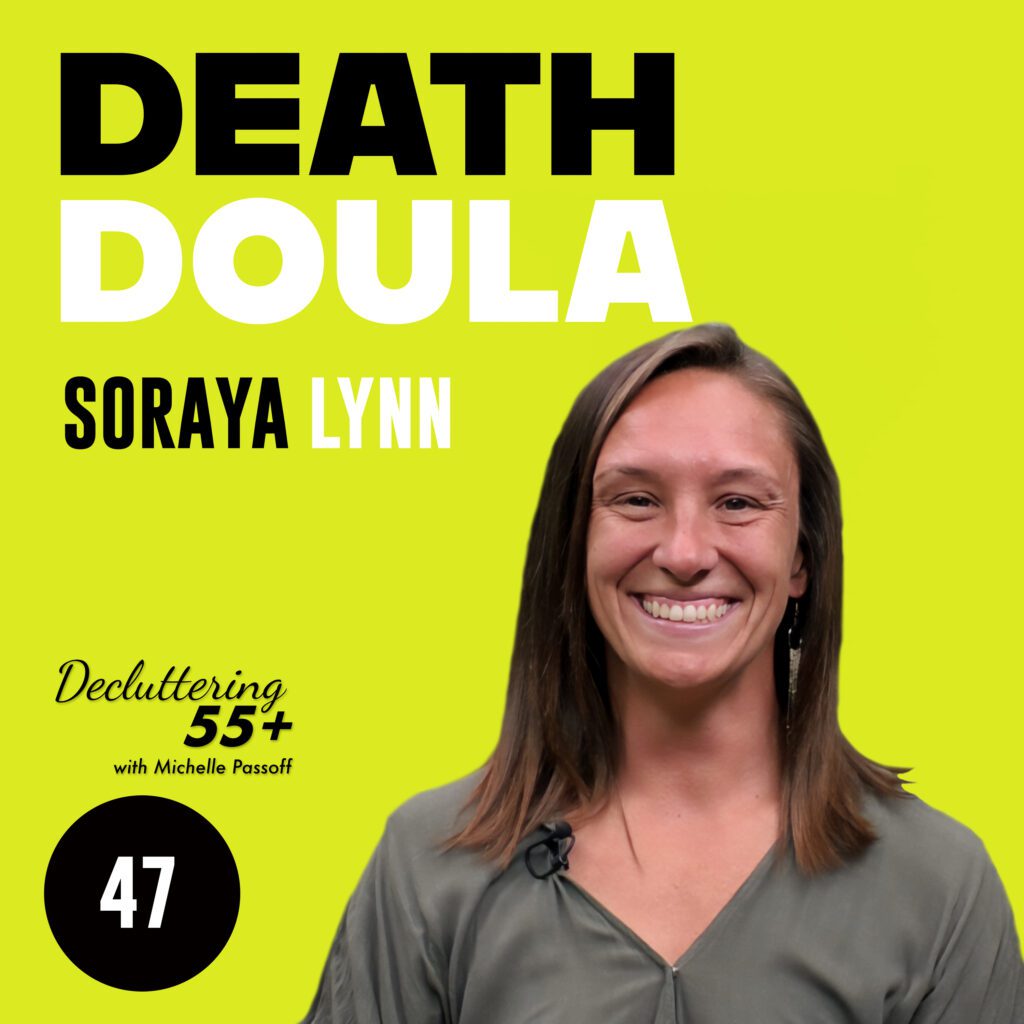
EP.47

Death Doula with Soraya Lynn

I was in ICU and I saw people dying alone inhumanely. Something inside of me just knew that there was a better way to handle this.

Summary

In this heartfelt conversation, we welcome Soraya Lynn, a former intensive care nurse turned death midwife and grief guide. Soraya shares profound insights from her work supporting individuals at the end of life, helping us reflect on relationships, purpose, and living fully. Her compassionate perspective offers guidance on finding peace in life’s final chapter.

Picture of Michelle Passoff

Michelle Passoff

Host of the Decluttering 55+ podcast and author of LIGHTEN UP: Free Yourself from Clutter.

More Posts

Ep47

Death Doula with Soraya Lynn

06/06/2025  - Podcast Transcript

Death Doula with Soraya

Michelle (00:31)

Welcome once again to Decluttering 55 Plus with Michelle Passoff for another engaging conversation about how we can create a legacy, not a mess, as we age. We not only talk here about conventional clutter, such as papers, clothes, and other stuff, we delve into next level clutter. Next level clutter are areas of life that we find baffling or confronting, so we sweep them under the carpet to put off another day or forever. It’s here that instead, we talk

with authors, authorities, experts, and geeks to help us clear things up and straighten things out by getting our questions answered so we can be freed up to take action and get things done. We cover areas of life including resetting your health and fitness regimen, digital decluttering, tending to social relationships, producing a memoir, deciding where to live and what to do next in life, getting our financial and legal papers in order, and pre-planning our final arrangements.

Today, the authority we have delighted to welcome to this conversation is Soraya Lin, who is no doubt an expert of a unique kind. Welcome, Soraya. Soraya is a registered nurse who worked for years in adults intensive care before becoming a death midwife or doula and grief guide. Soraya works with individuals to enable them to experience a peaceful transition and to provide a supportive service to their family and friends.

She is with us today to teach us what there is to learn about nurturing our relationships and living our best life from the people she has worked with who are at Death Store. Saraya, thank you so much for being here. I know this is a difficult conversation for a lot of people, but for you, it’s one that you’ve embraced after being a registered nurse for as long as you did. How did you come to become a death doula after being a registered nurse?

Soraya (02:27)

I was in ICU and I saw people dying alone inhumanely, especially through COVID. And the way that we handled death care, I just knew something inside of me just knew that there was a better way to handle this. And so I started doing research and I just, this word, this death doula word just kept coming up into my mind’s eye and here we are.

Michelle (02:53)

What is a death duel of them?

Soraya (02:55)

So death doula is a, they provide non-medical support to those who are dying, to their families, friends, and just offer support and guidance through the emotional process, through the dying process, through education, ⁓ know, whatever the family needs.

Michelle (03:13)

When do you, you know, sometimes, ⁓ you know, so the kind of death that you would deal with is death that you can anticipate rather than death that’s brought on by an accident? Both.

Soraya (03:25)

both. ideally as a death doula, you know, someone who’s diagnosed with a terminal illness and they have X amount of months to live working with them, building a death care plan is what I call it. And working with them to have the best end of life stages that they have. Now someone who, you know, suddenly died from an accident, working with their families to help them through the process would be more so on that end. So it can go both ways.

Michelle (03:54)

Now what if you there’s months before you know somebody is going to die How do you help them how often do you help them? ⁓ Is it converse like is it like going to a therapist like you go in for an hour and you chat or? What kind of service is it?

Soraya (04:11)

It depends on what the person wants and needs, the frequency of what the person’s nervous system can handle. Sometimes people want to meet once a week for a couple of hours. Sometimes they want to meet multiple times a week. And it’s, you know, sitting with them, getting the end of life plan together and doing a life review. Going through their life of sitting with the emotions of what they have, what they’re still holding on to. If they have a conversation they wanted to have with somebody in their family or a friend that they never got to.

and just working with them through that and then fulfilling their wishes so they have the autonomy and the empowerment to plan the end of life if they have that time.

Michelle (04:52)

What’s incorporated into a plan?

Soraya (04:55)

It

depends on what they want. Sometimes it’s energy work, breath work, ⁓ embodying the emotions that come up. sometimes it’s talk therapy. Sometimes it’s saying what they wanted to say to that person and they can’t say it to that person. So they just speak it out loud to get it out of the body somatically. And it varies. It’s very tailored to each person and what their needs are. Are they able to move or not? Are they at that stage yet?

Michelle (05:21)

And what kind of services do you provide for the family and how is that balanced with working with the patient, so to speak, and the family?

Soraya (05:31)

It’s a fine line, ⁓ so it doesn’t get intermingled. ⁓ Sometimes the dying person wants their family in with them. Sometimes it’s completely separate because the family is so taxed and there’s this burnout stage and they want to detach and there’s sometimes guilt around.

the relief of that person finally passing. So working with them through that separately or together, both are very cathartic for both parties.

Michelle (06:02)

Is being a death jewel something that is ancient or is this something that’s a new field?

Soraya (06:11)

no, it’s ancient.

It goes way back to how our ancestors handled death and care, death care in general. ⁓ you know, I educate people on home funerals and that’s how our ancestors did it. They blessed the body, they dressed the body, they spent the time with the body and that was cathartic. That’s where grief comes up and people are allowed to grieve. And today’s society says, no, we don’t grieve in public. We sweep it under the rug and we go on about our business. And that’s, you know, that’s not how we did it. So it’s ancient. It’s so ancient.

Michelle (06:41)

And is it a growing profession, is it a renewed growing profession and why is it growing?

Soraya (06:48)

That’s the question that I’m asking myself is I feel as though people are coming more online and seeing that death is sacred. It’s a sacred transition and how we’ve been handling it is not the way it’s meant to be. And I think a lot of people are coming to that awareness of it all and just stepping into the role they’re answering the call. I feel like there’s a specific person that gets the call and they answer it and they step into it.

Michelle (07:15)

How do they find you? So they wake up and go, God, I need help dying and I’m gonna give call to the Soraya. How do they know about it? Yeah.

Soraya (07:25)

So depending on where people at, know in Florida there is, it’s called Florida End of Life Death Dula Alliance. It’s F-E-O-L-D-A.org. There’s a whole directory of ⁓ death doulas in Florida. If they’re out of Florida, they can go to deathdoulas.com and they break it up by state, region. It’s a whole breakdown system. And then you just search to see which one fits your needs.

Michelle (07:52)

Do the assisted living facilities or nursing homes or hospitals have that as a resource or not so much? No.

Soraya (08:01)

And that’s

one of the things that I’m working towards to normalize and break the stigma that we work alongside healthcare professionals. We’re not there to get in the way. And some people think we’re there to get in the way, take the job, but we’re the ones that can actually sit and spend the time with the families because nurses can’t do it. Doctors definitely don’t have the time to do it. Social workers are busy finding resources for them.

Michelle (08:24)

So it’s really an emotional, like kind of an emotional, you take them on an emotional journey.

Soraya (08:35)

with the services that I provide.

Many different doulas, some strictly do the paperwork, the legality of it, getting all of that squared away. Some people work solely on legacy work and that’s building the legacy around somebody after they pass. ⁓ I would consider myself a spiritual death doula where I encompass the emotional aspects of it, working with the physical body and things like that and ⁓ making them have a safe transition.

Michelle (09:03)

What have you learned about life from helping people transition? ⁓

Soraya (09:09)

That is a loaded question and I will do my best. It’s to not take it for granted, to really under see the little simplicities that the mundane, finding the joy in the mundane and to move fearlessly with it all. Cause we do, we get fearful or ego gets in the way and it’s like, no, I can’t do that. So yeah, you can do that. My clients have taught me that. Be fearless.

Michelle (09:35)

Be fearless.

And what about regrets or resolution of relationships that may be broken in life? do people cope with being complete when they pass?

Soraya (09:49)

It’s such an important

aspect of it because people will struggle to transition if there is unresolved business, unresolved relationships, things that they, like I said, wanted to say to somebody, thing that somebody did years ago that they’re just gripping onto dear life and…

working through them or working through that with them in a life review, having them visit that without re-traumatizing them if it was traumatizing, but having them visit that and sit with it and really nurture it and come to a place of acceptance.

Michelle (10:19)

And how does that show up if somebody has a death doula there beside them versus somebody that doesn’t? What difference does it make in the passage?

Soraya (10:31)

It allows a smoother one because just like our ancestors did, dying is meant to be in community. And when someone is alone or they have that family member that irritated them their entire life and they don’t know how to cope with that, having ⁓ like a mediator basically to hold the space and have the support knowing that they can gracefully just like breathe and let go.

It’s almost unexplainable of how it happens. It just does, it’s magic.

Michelle (11:03)

So each

experience with ⁓ a different client, do you call them client? Client is a different experience.

Soraya (11:10)

for

every single time, every single time.

Michelle (11:14)

So what should we fear about dying? About dying. Nothing to fear about dying. That’s a relief.

Soraya (11:20)

There’s nothing to fear.

The only

thing that we fear is the programming that we’ve taught, whether it’s through beliefs that we learned growing up of it’s really scary and also depends on your religious beliefs and things like that. And there’s really nothing to fear. And I’ve delved in a lot of near-death experience type stories and they’re all the same. People experience this great amount of love and when people are in their last final days, you can start to see that.

You see this calmness wash over them and it’s like this they’re in this blissful space

Michelle (12:00)

Is there an average amount of time in which you will stay with a client and their family?

Soraya (12:08)

Not necessarily, again, goes back to like what they need. If they only want me to be there for with them for a month, we’ll do that. If they only want me to be there to plan how they want their end of life and sit with them as they’re actively passing, sometimes it’s just that too.

Michelle (12:22)

And how much does it cost?

Soraya (12:25)

depends on the person providing the services. Ideally…

Michelle (12:29)

Is there a

range? Not really. You just have to do your research.

Soraya (12:32)

No.

Yeah, and a lot of us doulas really, because it’s heartfelt, it’s heart work, and we want to do it for free. And some people can do that, and other times it’s, you I would say it’s average. It’s difficult to put a price on it because of what people are receiving. It’s just.

Michelle (12:57)

So just ask. Okay. What, do you have any wishes for yourself in terms of your own passing? So one thing is to think about that beforehand, what you can learn from a death duel is what to think about in advance. Of course. So what are you thinking about?

Soraya (13:06)

I do. You do? Yeah, I do.

Well, a lot of people fear their own mortality and it’s facing mortality and realizing like, ⁓ I’m not, I’m going to go one day and it’s building a plan. I already have a plan and I want certain people around. I want music. I want as peaceful and calm as I can be given that I can be at home in nature. Put me outside and let the sun hit my face and be surrounded by nature.

Michelle (13:41)

Can you give us some examples of different things that surprised you that people wanted at store?

Soraya (13:49)

Not, not really. It’s almost the same. They just want peace, calmness. There have been, there was one I was like, I absolutely do not want this person around. And some people want smells. Another person, their family was putting lavender lotion on them and they didn’t like the lavender, but they couldn’t, you know, it was, they just didn’t like it. And so, yeah, it’s, I don’t know. It’s, it’s, each one’s different.

It’s hard to explain.

Michelle (14:19)

⁓ How long after somebody passes might you work with the family?

Soraya (14:26)

Typically you want to make that separation ⁓ maybe a month. If they need more than a month, then that’s, but typically the mark is when grief reprocessing happens and they’re able to really accept. And then I teach and guide them how to move forward with grief so that they’re not solely relying on me. That’s not the goal. Like if they need my support, obviously, but. ⁓

It’s to get people to a place where they can dance with their grief, because that’s basically what’s left after someone passes.

Michelle (14:58)

you

I know that in my own case I had ⁓ lost a brother and my father within six months of each other and I went to a counselor and I found ⁓ he said it was a rabbi and he said to me everything is in divine order and you know what that enabled me to do it enabled me to separate ⁓ what happened from grieving, grieving you know and I was able to accept at the same time grieve and that there was a lot of ⁓ I still think about it

30 years later now, because he was younger when he passed away. Both of them were young when they passed away. And it gave me a lot of relief to be able to separate the grief from ⁓ the moment. Accepting.

Soraya (15:43)

Yeah,

and that’s the goal is to get to acceptance because grief isn’t going to go anywhere. It’s with us along.

Michelle (15:48)

for

the ride. Yeah, that’s a lifetime. You can grieve that loss and that emptiness and they’re not participating in this. And I often sometimes say even to this day, wish Todd was here. I wish dad was here. But there’s an acceptance that that’s the way it turned. It didn’t only happen to them, it happened to me. therefore, the reason to think about having a death duel if somebody in your life has passed to usher you

through your next hand transition. know as a clutter consultant I go into sometimes I go into people’s homes and they’re holding on to their stuff for years and years or holding on to ⁓ the emotions for years and years and just because you let go of the stuff or the emotion doesn’t mean you know you’re letting go of them so ⁓ acceptance goes a long way I think. ⁓

And we think to have a midwife there, a birth doula, is something that everybody can have, but we don’t think of a death doula. So this is something new and something, is it growing, that profession?

Soraya (16:56)

It is. It’s growing quickly. ⁓ I don’t know that enough people know about it. The main corner store of being a death doula is education because not a lot of people know about it if they know about it they don’t realize the importance of having one of us in their life as this major transition is happening.

Michelle (17:16)

So you might find out about somebody else who’s done it. Maybe you observed in somebody else’s family ⁓ that it’s done. What is the training for it? What kind of backgrounds do people who are death doulas come to the profession with?

Soraya (17:29)

All kinds, social workers go through the training just to have a better understanding. A lot of healthcare professionals have gone through the training. My training was three weeks online, meeting twice a week. So it depends on what program you go to. There’s several programs out there for dualists to get their training and get their certifications and things like that.

Michelle (17:49)

Is

there a particular, ⁓ if I’m wanting to retain the services of Death Duel, is there certain questions I should be sure to ask to know if they’re the right one for me?

Soraya (18:00)

Yeah,

mean, if you just let’s say what you need. This is what I’m going through. This is where I’m seeking help. And can you provide that for me? And I’ve had a lot of people were come to me and I don’t do those things that they need and I’ll refer them out. There’s a whole referral network out there.

Michelle (18:15)

So it’s death being a death duel or retaining the services of death duel is not something that falls off everybody’s lips. So it’s something to look into, to research, and to kind of be mature enough to accept that it’s inevitable that either somebody we love or ⁓ our own selves that we’re going to pass one day and that you don’t have to do it alone. You don’t have to live alone. You don’t have to die alone. So we’re going to have to wrap it up for today.

If you’ve never thought of or known of a death doula, it’s something that you may lean on for support one way or the other. So I want to thank you, Soraya, for coming and sharing your experiences so that all of us in the audience can benefit by them. And if you want more information about death doulas and Soraya Lin, you can go to www.ayalin.net. ⁓

You can also find out more information about death doulas at the website for the International End of Life Doula Association. That is www.inelda.net International End of Life Doula Association. I want to encourage all of you out there to join the Decluttering 55 Plus community by visiting our website at www.decluttering55plus and ⁓

hitting that Let’s Connect button. We keep in touch with you and you can keep in touch with us. I hope you’ll do that so we know about your challenges, what your stumbling blocks are, and what are the solutions and resources you’ve found that can make a difference for others. ⁓ Again, go to www.decluttering55plus.com and sign up for our mailing list. Also, pick up a copy of our illustrated spiral book called Decluttering 55 Plus.

Wisdom’s to create a legacy, not a mess. It sits like a tent on your desk and you can turn it to any page and leave it there for a day or a month or a week and let the message compel you to get your questions answered, inspire you to get things done. You can buy it at amazon.com or www.layitflat.com. If there’s a topic you want to be sure we cover on this podcast, please sign up for the website by pressing the let’s connect button.

and let us know what you want to hear. In the meantime, be sure to get out there, take the initiative to get things done. That’s all for today, folks. We’re gonna sign off now, so all you have to do is be sure to have a clutter-free day. Thank you.