

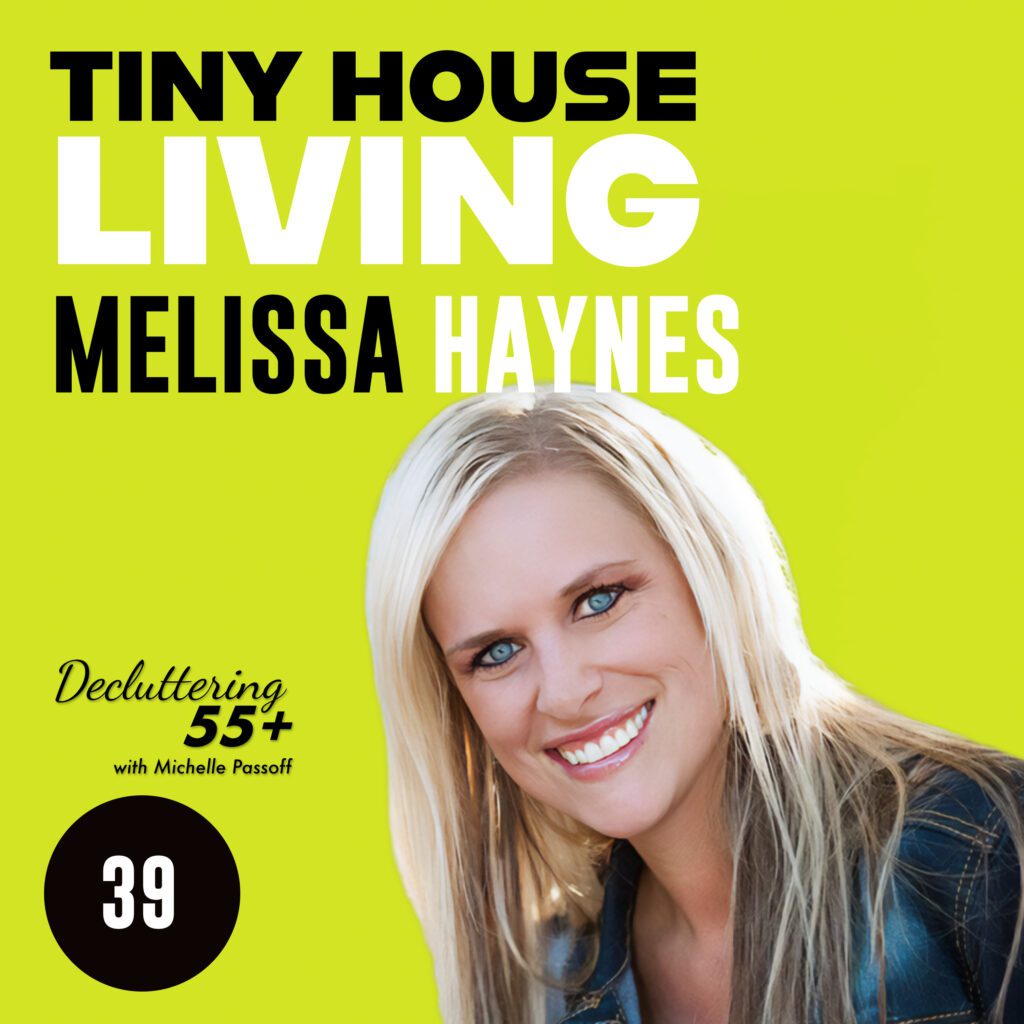
EP.39

Tiny House Living with Melissa Hayes

So that's where the park model tiny homes are a very good option for the 55 plus community because they have a bedroom, a bathroom, living room, kitchen, sometimes dining room, all on the first floor.

Summary

In this episode, we talk with Melissa Hayes, a seasoned real estate professional and founder of Liberty Tiny Village, a 55+ community in Aubrey, Texas, about the growing appeal of tiny house living. As people enter new life chapters, decluttering and redefining their lifestyle—health, finances, relationships, and housing—can open the door to simpler, more intentional living. Melissa shares how she transitioned from traditional real estate to creating a vibrant community centered around the tiny home movement.

Picture of Michelle Passoff

Michelle Passoff

Host of the Decluttering 55+ podcast and author of LIGHTEN UP: Free Yourself from Clutter.

More Posts

Ep39

Tiny House Living with Melissa Hayes

04/11/2025  - Podcast Transcript

Tiny House Living with Melissa

Michelle (00:30)

Welcome once again to Decluttering 55 Plus with Michelle Passoff. We’re here every week with experts, authors, authorities, and geeks to chat it up about ways in which we can invigorate our lives and make room for what matters. If you’re confronted or confounded by something in your life, we call it next level clutter. Instead of sweeping it under the carpet and putting it off another day or forever, we bring challenging topics into the light of day, we examine them, learn new things.

get in action and get things done. Conventional clutter is generally understood to be papers, clothes and other stuff. Here we talk about it in an unconventional way, not only as a way to be neat and tidy, but as a little known and underused way to move and manage life. So you clearly define the direction you want to be headed and you achieve it with as few obstructions and as little stress as possible.

Next level clutter goes beyond conventional clutter. Here we help you sort things out so you don’t stay stuck in confusion or fear. Next level clutter includes resetting your health and fitness, an eating regimen, digital decluttering, preparing a memoir, healing, letting go, or creating social relationships, deciding where you want to live and what you want to do next in life, getting your financial house and legal papers in order, and even pre-planning your final arrangements.

Some folks choose to stay in their homes where they have long lived to work and raise a family and others choose to make a change after retirement. The big question is where? Today we’re going to talk with Melissa Hayes because she knows a thing or two about tiny house living and that is one option. Melissa has been involved in real estate as a property manager and development professional for more than 25 years. Now…

She’s the owner of the Liberty Tiny Village, a 55 plus community located just north of Dallas, Fort Worth in Aubrey, Texas. Hey Melissa, I’m so glad you’re here to tell us all about tiny house living so we can see if that’s the housing choice for us in our future. So how did you get on the scene in the house, tiny house? How did you move from regular property to tiny house living?

Melissa (02:50)

Well, we wanted to get into a business that ⁓ had a little bit more legacy as far as intentional with relationships. We still wanted to be real estate based since real estate has really done as well, but we had been in storage and vacation rentals. And so we just wanted something that would fill the market ⁓ where there was kind of like a gap. And we, as our parents aged and our grandparents age, we really saw that there wasn’t a lot of options

for the 55 plus community. And so we wanted to be able to offer something that was meaningful, but that still stayed in the real estate lane.

Michelle (03:28)

And tiny houses, there are tiny house communities that are for all ages, but there are some that are specifically for 55 plus. How pervasive is that around the country? Is that ⁓ growing? Is it reducing? What’s the status of tiny houses for 55 plus?

Melissa (03:48)

I would say that it’s growing exponentially. think for a little while people kind of just watched to see what the market was when tiny houses came on the scene. I think it was more for the nomadic traveler. Typically it was younger age groups, but then as people have, manufacturers have evolved their building and made them more built with stick build materials and they’re becoming more. ⁓

They’re still movable, but they’re more of a stable structure, and so the longevity that they the homes are built with last a lot longer, and so I think it started to appeal to different age groups, specifically the 55 plus who wanted still a nice house. They typically live in nice houses, but they just needed it smaller because their mobility was changing. They wanted to be closer to family that could kind of help. You know ⁓ they want to see grandkids.

and they might need a family’s help with moving stuff around or moving furniture or helping with outdoor work. And so I’m seeing the 55 plus community really take a hard look at it. And now that the market has gone so high, they’re able to sell their home that they’ve had for a long period of time and actually pay cash for tiny homes.

Michelle (05:05)

Now how big is a tiny hum? When you say how big is a tiny hum?

Melissa (05:11)

So tiny homes as an industry can start anywhere from 100 to 200 square feet. We sell what’s called a park model tiny home and the park model tiny homes are 399 square feet. And the reason that 399 is such a specific number is because the RV category ends at 399 square feet and real property begins at 400 square feet.

So we are the largest tiny home that will still have an RV title. So you just pay sales tax instead of the property tax.

Michelle (05:45)

So you don’t have to pay a property tax after you buy the home.

Melissa (05:52)

Well, that is correct in our area. Every jurisdiction is is figuring this out. This is like I said, a new lane that they’ve never experienced before. People have had fifth wheels and travel trailers, which is the category that this goes in. But for people to live on it or more longer term basis, it’s still seasonal living because they may go on vacation or stay with family and travel, and so it’s not their permanent residence. But ⁓ so cities shouldn’t be.

Charging property tax, but the cities are still kind of figuring this part out. But in our area, there’s no property tax.

Michelle (06:28)

Well, that’s certainly an advantage. Now, when I think, see, I get a lot of pictures of tiny homes across my Facebook feed, and most of them are two story. Is it a little hard for 55 plus people to climb up those skinny stairs to a loft, or how is it designed to be more fitting to a 55 plus-er?

Melissa (06:51)

So that’s where the park model tiny homes are a very good option for the 55 plus community because the park model tiny homes have a bedroom, a bathroom, living room, kitchen, sometimes dining room, all on the first floor. And if it has what we call a loft, a second floor, that is typically for storage or extra sleeping areas, but the main bedroom is down on the first floor.

Michelle (07:17)

I see, well that’s a plus there, because it’s a little hard to climb up those skinny stairs. What about storage? How hard is it for people to pare down all of their belongings that they’ve had in a 2,000, 3,000, 4,000 square foot house to 399 square feet? And what do they do with all that stuff?

Melissa (07:42)

So we have a declutter that we work with locally. Her name is Brittany and you can hire someone like her who will come in and they’ll teach you different tips and tricks on if you’re like you want to start in one room. So say you’re going to start with your clothes turn all the clothes in your bedroom the opposite direction the hangers and then wait six months and see which ones you haven’t touched. So they can start. She has different tricks and tips that she can start to

to kind of help you with to break some of that down to see what you’re actually using. And as far as the storage at the actual house, like I said, a lot of the lofts are very large and have ⁓ a large space upstairs if you choose to get a loft where you can store things. And then the way that we skirt our homes is we create opening, storage openings under the home. So we have one to two areas underneath the home that you can also put pavers down.

and store quite a bit of a few things down there. So Christmas decorations, maybe you like to go to the lake and you have a kayak or you have bikes or something that you wanted to store under the home, you would be able to do that in a, you know, a tub, a plastic tub.

Michelle (08:57)

Sounds good. And I guess you’re not gonna move into a tiny home if you’re gonna keep everything that you had from a large home. So you have to change your mind when you’re moving into a tiny home. But one of the incentives I would imagine would be the social aspects of it. What kind of amenities do you have in your village and what can people expect around the country to foster social connectedness between homeowners and have a great life in

community.

Melissa (09:28)

Okay, well, I would say that our community is very ⁓ relationship driven. So we have monthly activities where we get together and sometimes they’re themed for the month. Sometimes it’s just kind of a hangout to catch up with everybody. And so it’s very relationship based. Now, as far as amenities, we have a community kitchen, we have a community outdoor gathering area that has a grill space, we have walking trails, fire pit, we have

a ⁓ swing garden. And then we also later this year, we’ll be building a pool, a hot tub, another community center that’s much bigger, a fishing dock and a chapel. And we also have a stocked fishing pond on the property as well.

Michelle (10:16)

So you have your privacy and your tiny home, but you have a community that’s nearby. you near, are you and then tiny villages, are they near cities, far from cities? Do you have a choice of greater community that you can choose from?

Melissa (10:36)

Okay, so I would say that our community is probably the closest one that I’ve seen to a Metroplex area. So we are part of the Dallas-Fort Worth Metroplex, but we’re actually about 10 miles from Denton and about 10 miles from Frisco. And so that’s where we have the PGA headquarters. We have the STAR, the Dallas North Tollway. So it’s a five minute drive to Walmart, CVS, like the major big box stores, pharmacies, doctor’s offices. Those are all within a five to

20 minute drive of your tiny home community where we are. I would say that most tiny home communities are much further out into the city because of land costs. We got pretty lucky when we purchased this land seven years ago. The area that it’s in had not quite developed yet. And within that seven years, it’s all the cities come straight to us. So but we’re right on the edge of the country. So you definitely have the country.

feel we have lots of trees on our property, but and you know, we’re right there close to the city and all the things that you would need on a weekly basis.

Michelle (11:45)

When somebody wants to try Tiny Village ⁓ living out, can they do that? Is there a place to go where you can kind of test the waters before you dive in?

Melissa (11:57)

Yes, so we also own a tiny home dealership where we just sell tiny homes and we ship them nationwide or into local communities here or into our community. And so part of Liberty Tiny Homes dealership is we have what’s called a try it tiny program and the try it tiny program ⁓ gives you the ability to rent a tiny home by the night and ⁓ give it a try.

Michelle (12:22)

Well, that’s ⁓ certainly an advantage. ⁓ What is the cost? I want to scroll back to the beginning of the conversation about buying a tiny home. How much does it cost? And then how much does it rent to, how much does it cost to rent to try it out? Can you answer both questions?

Melissa (12:40)

Yes, yes. So our tiny homes is there the park model tiny homes, the largest in the tiny home category are park models. We have three different manufacturers and so a lot of it depends on upgrade. So I’ll give you our range. Our range is anywhere from seventy five thousand up to a hundred and sixty thousand and the closer you get to the seventy five thousand, then that’s going to be more basic, you know, for my account or tops, not much backsplash, you know, linoleum, Florida link.

flooring, the basic cabinets, it’s livable, but it’s very basic. But when you get closer to the 160, that’s hardwood floors, that’s granite countertops, indoor fireplace, outdoor fireplace, lots of different upgrades, specializations, maybe you wanna add a bunch of extra windows, different ⁓ finishes, upgrade appliances, stuff like that. So there’s definitely a range for people with all different budgets. As far as renting the tiny home by the night,

That is set up. We’ve got it on our website where you can rent directly through our website or you can rent it through Airbnb and Our prices range for anywhere from $80 to $200 a night and that’s just depending on the dither rentals in our area So there’s a company that we use that ⁓ they just go by supply and demand and so that price can change

Michelle (14:01)

What’s the resell? Can you bring in, if you have a tiny home in another city, can you bring that into your community or another community and park it in your community?

Melissa (14:15)

So if you have an existing, if you have an existing tiny home already, we do have communities that we can direct you to where you would be allowed to bring that tiny home into their community. But if you want to come into our community, you would need to purchase your home from Liberty Tiny Homes.

Michelle (14:31)

So you keep, is that for style purposes? Like you wanna keep a certain style within the community?

Melissa (14:38)

Yes, yes, we want to keep a certain style and we want to only have RVIA certified homes. So the manufacturers that we work with are RVIA certified. So we know that those homes are built to a certain standard and to a certain code. And so we know the quality of the home and that it will last.

Michelle (14:58)

Okay, well that sounds good. And why do people choose, why do you find people choose tiny homes?

Melissa (15:07)

I think since COVID, it’s really kind of opened people’s minds up to the value. What is the value that they want in life? know, throughout a life, if you look at 55 is still pretty young. They’ve gone through the childbearing years. They’re getting into grandchild stage. They’re looking at retiring fairly soon. And so they are now looking at their life from a different perspective. And so,

⁓ It’s less about stuff. think that the older people get and it’s more about relationships being closer to the people that they love seeing places that they’ve always wanted to see. You’re getting some of those items checked up off the bucket list and I think a tiny home gives you that ⁓ either financially it gives you a better option to do that and then you know being in a community like where we are that’s gated. That’s more of a lock and leave. People are here able to watch the house.

or maintaining everything outside. So they can lock their house and leave to go see Europe for a month. it’s, you know, everything, all the bills are included in the house with the exception of the electric. And that’s something that can be paid online. So there’s really nothing that would be, you know, locking them here. So that’s what I’ve kind of seen with people.

Michelle (16:29)

Well, that sounds like fun. ⁓ Do ⁓ you recommend that ⁓ people hop around the country from a tiny home community to tiny home community as a way to check off their bucket list, or is it a stay put ⁓ kind of proposition?

Melissa (16:50)

So our tiny homes, like I said, are the park model tiny homes. So they have to be moved with a semi. It’s actually called a toter truck because they’re close to 30,000 pounds, 30 to 40,000 pounds. And so it ⁓ is not exactly ⁓ inexpensive to move these on a regular basis. So it can be moved. Like if you were going to move it from one place within a hundred mile radius, it would probably be like a $4,000 charge if you were to move, you know, anywhere within a hundred miles.

Thank

Michelle (17:21)

So you’re not gonna really think of it as an RV. Even though it’s classified as that. So if somebody wants to find out more about tiny house living, what do you recommend they do? Should they go to your website? Is there an association? Are there ⁓ trade shows? How should people find out more about tiny homes?

Melissa (17:44)

So I would say our website, Libertytinyhomes.com, that’s our dealerships website. We have a frequently asked questions page on that website and it answers a lot of questions about the tiny houses themselves. So if you kind of want to know how it works and what’s included and what gets added, just how specific questions, you’ll find some great answers on the Liberty Tiny Homes page for that. As far as Facebook groups, there’s a Facebook group that we’ve worked with and actually

who have purchased homes have done ⁓ walkthrough tours of their homes with this group. It’s called Tiny Home Tours. And so that will give you, it’s people who live in tiny homes and they’ll give you a walkthrough, tell you what they like about it, why they did it, how it’s changed their life, all those kind of things. So that kind of gives you like a, it’s not a company trying to sell you something, it’s a person who.

who lives it and who loves it and is just sharing their experience. So if they kind of want a non-biased opinion of tiny home living, I would say that that’s probably a great place to start. ⁓ Our website, libertytinyvillage.com will give you lots of information about our village specifically. So it kind of depends what stage in the process they are. As far as conferences go,

I can’t say that I would recommend a specific conference at this time that I felt would be good for a consumer to give them a full idea. They kind of need to figure out which type of tiny home and before, because the conferences are very

⁓ more of the towable tiny homes that you’ve tied tow behind your house. Some of them are more for park models, some of them are more just for people like us dealers.

Michelle (19:37)

Well, whatever you’re doing in the 55 plus range in life ahead, it takes initiative. So that’s all we have time for today to talk about tiny homes, but ⁓ please take ⁓ initiative to ⁓ find out what you need to. I want to thank you all for coming here today. Don’t wait another minute to check out.

Libertytinyvillage.com. And while you’re at it and you’re Googling around, go to www.decluttering55plus and click on the Let’s Connect button to find out about our community. Then you can get all the news and information from us when we have it. Also, tell your friends and family to do the same so that together we can make room for what matters. And if you haven’t gotten a copy of my newest book, run out and get a copy for yourself, your family, and your friends.

It’s an illustrated spiral book of wisdoms that sits on a desk or a countertop. You flip it to any page and the message that comes up will inspire you. It’s called Decluttering 55 Plus, Wisdoms to Create a Legacy, Not a Mess. You can find it now, finally, on Amazon.com and a company called Layitflat.com. They’re a company of spiral books. Let it motivate you on the path ahead.

Before we completely wrap up things today, please know that we want your feedback. ⁓ What you like, what inspires you, what didn’t you hear that you’d like to hear. Share your challenges, your triumphs, comments and questions, and like, follow and subscribe to us on Instagram, Facebook and YouTube. The whole shebang. It will make all the difference in the world for us and hopefully for you too.

Okay folks, so thanks again for stopping in at Decluttering 55 Plus with Michelle Pasoff. Until next week, get out there, get an action, and have a clutter-free day.