

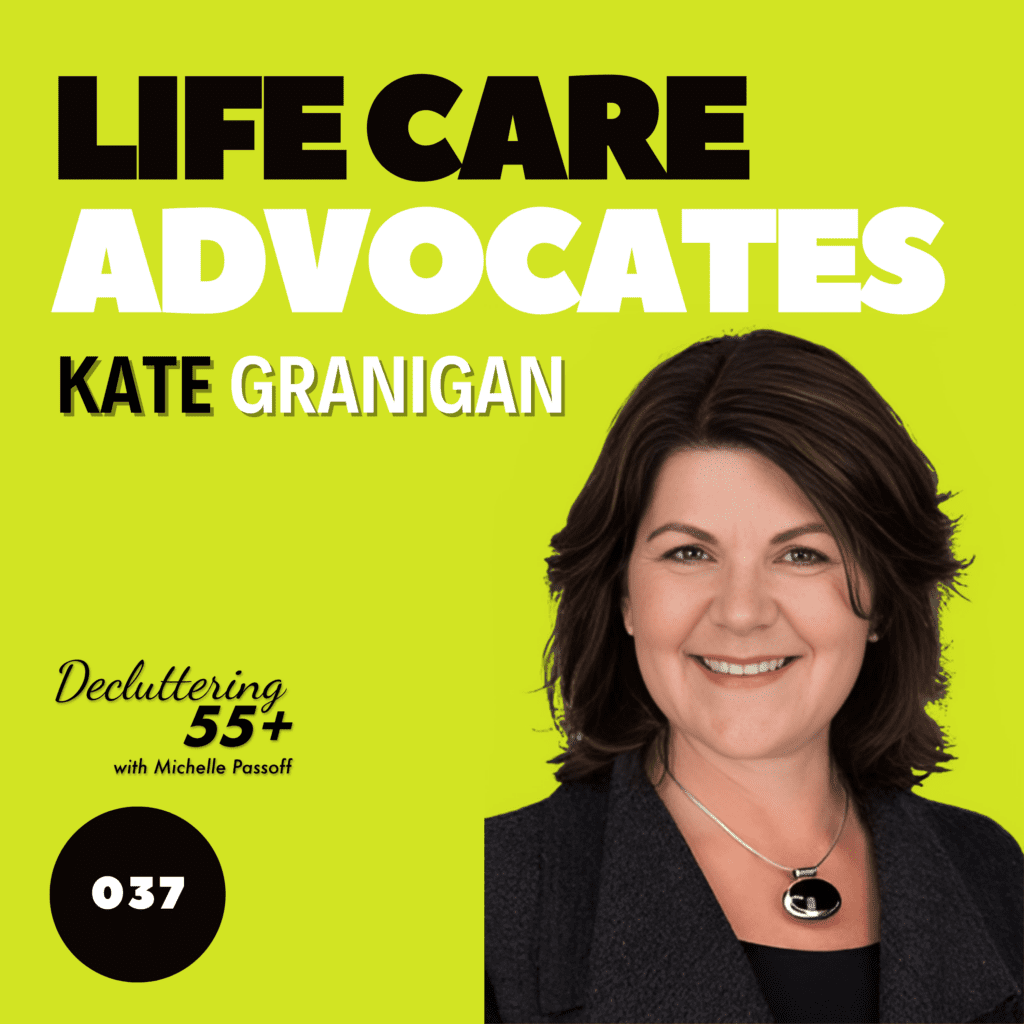
EP.37

Life Care Advocates with Kate Granigan

Aging Life Care Associates is a one-stop shop for reaching out to all different professionals you might need in all aspects of life as you age.

Summary

Kate Granigan, a geriatric social worker with 25 years of experience, encourages proactive planning for aging to avoid crisis situations in health, home care, finances, and legal matters. As CEO of Life Care Advocates and president of the Aging Life Care Association, she provides resources and guidance to caregivers and seniors alike. Her message underscores the importance of facing aging head-on rather than delaying important decisions until it’s too late.

Picture of Michelle Passoff

Michelle Passoff

Host of the Decluttering 55+ podcast and author of LIGHTEN UP: Free Yourself from Clutter.

More Posts

Ep37

Life Care Advocates with Kate Granigan

03/28/2025  - Podcast Transcript

Life Care Advocates with Kate

Michelle (00:30)

Welcome to Decluttering 55 Plus with Michelle Passoff. This is the place to come for news you can use to get things done. Everybody knows that too much stuff is clutter and cleaning it makes you neater and tidier. To us, it is a life management tool that helps you navigate your next steps. This is what my book Lighten Up, Free Yourself from Clutter is all about. As Baby Boomers, we have a lot in front of us that is confounding and confronting.

So we sweep things under the carpet and put them off another day or forever. That is clutter because it keeps us stuck. And my new book addresses all of that. So we’re going to bring experts, authors, and authorities here to talk with us about health, relationships, technology, finance, housing. What are you going to do next in life, passing down your life stories, and even the challenges of making final arrangements. Here we aim to learn.

open new possibilities, choose, take action and create a legacy, not a mess. So let’s get started. Even though aging is inevitable, when it comes to planning for it, many of us kick the can down the road. You may be chanting the anthem of the cluttered among us. have to, something else to do today. I have other things to do tomorrow. If you sing that tune long enough, when the time comes that you need healthcare, home care, financial or legal advice, you may find yourself in a crisis.

making your issues more difficult or impossible to address. Kate Granigan is joining us today from Boston, Massachusetts to help us grab the bull by the hornets and take those blinders off. She will look with us at how we can improve, how we prepare to take good care of ourselves as we shall we say, mature. Kate is a 25 year veteran geriatric social worker who often lectures and writes on the issues related to caregiving, dementia and related projects.

She is the CEO of Life Care Advocates and president of an organization called Aging Life Care Association, a resource for services every caregiver and senior wants to know about. So let’s get talking. Welcome, Kate. Thanks for being here.

Kate (02:40)

Hi Michelle, happy to be here.

Michelle (02:43)

Thank you. Well, aging is inevitable when we need different kinds of care is unpredictable. So this begs the question, when should we start planning for a time when we may not be as independent as we are now?

Kate (02:57)

You know, that’s a great question. And I guess the easy answer is it’s never too early. But you were early to plan. OK, I think it’s important to recognize that making a plan or starting to be an educated consumer about what what it means to be getting older and what kinds of resources are out there. You know, it doesn’t mean you have to use that or that that script doesn’t change. You know, really just help to start thinking about what you need to know.

Michelle (03:04)

man

Kate (03:27)

so that you’re not stuck with a lot of surprises.

Michelle (03:31)

So then the Asian Life Care Association members are comprised of what types of professionals and when and where and how are they a resource?

Kate (03:45)

Sure. you know, as a, the current president of the Aging Life Care Association, which is a membership organization across the country with folks that are ⁓ trained professionally in things like social work, nursing, physical and occupational therapy, healthcare administration. And, you know, as association members, we abide by a code of ethics and a standard of practice that helps us to help.

older adults and those preparing to be older adults to objectively navigate what’s out there. So you can find an aging life care ⁓ associate member in your backyard likely.

Michelle (04:26)

Well, that’s comforting to know that you can get help. And the whole thing is, I’ve heard it said that it’s a holistic practice. And what does that mean exactly?

Kate (04:38)

Sure. So I mentioned the way that many of us are trained and licensed, but the difference in working with and being part of someone that working with someone that’s part of the age and life care association is we, we pride ourselves in a ⁓ holistic approach of understanding and helping our clients age and age with dignity and have resources to do that. ⁓ Holistic is really looking at the whole person. We’re not just our medical needs. We’re not just our

finances or our housing needs, we are all those things. Also, we have unique understandings and goals as we age. We have various interests. Many people age with a partner. Others are what we call solo agers. So there are a variety of things that really need to be explored and understood to help someone have a plan that fits them, a unique plan.

And really as an aging life care manager, that’s our job. It’s to know all the aspects that someone may not even think about because they haven’t been down that path yet. But we have, we’ve walked this journey with other people. And so we come with questions and areas of knowledge that can really help you get quickly to the things you need to consider, if not now, in the future.

Michelle (05:55)

Where do you start? When you want to make a plan, where do you begin?

Kate (06:00)

Sure. Well, you know, if you’re choosing to use an aging life care manager, then you’re going to want to find one that you can work with in your area. The easiest way to do that is to go to our website. It’s www.aginglifecare.org. That opens up with a very clear orange button that says, find an aging life care professional. And then you click on that and you have the opportunity to put in your zip code, a distance, a range around you, knowing that if you live in New York City or in Florida or in Boston,

You might have a whole bunch of drones throw away. If you live in a more rural area, you might have to expand that geography search. there’ll be somebody that you can contact and ask questions about their practice and how they will help. They should be able to articulate that very easily.

Michelle (06:47)

And you don’t have to be sick in order to do this. You don’t have to be planning to move in order to do this. you know, just if you’re looking ahead to taking good care of yourself as you age, you can get started by contacting a couple of professionals in your area from the Aging Life Care Association to start guiding you where to even look. So do you put a plan on paper before you…

have these needs for healthcare and ⁓ housing, where do you, what’s the next step? You to find the person.

Kate (07:24)

Sure, and whether you’re working with an aging life care manager or not, I would tell you that putting a plan on paper is critical. And the first thing we help people do is know what they have put on paper, looking at have you done your legal documents? Do you have a healthcare, know, in different areas, it’s all different things, different states have different terms, but generally speaking, there’s two important documents that one should consider.

the healthcare proxy being one of them after your term’s 18, having someone that can speak for you if you’re not able to speak for yourself, even if just in a moment of a crisis or an accident, unexpectedly. So a healthcare document and then the document that allows someone to help with your finances and make financial decisions should you struggle with that or need help are two documents that an attorney, an estate or a trust attorney or a elder law attorney can help with.

B

Michelle (08:22)

So

you would have your tentacles in the community and say, you need these documents and these are, you would make recommendation as to who could put those documents together for you.

Kate (08:33)

That’s right. So we, as aging life care managers, part of our job is to help you know what you need and then be able to make qualified quality recommendations to those in our area that we work with that do that. And the experience we have in finding those anywhere from an attorney to a financial planner. We often even know people who do, we know people who help people downsize, people who help people relocate. We have recommendations typically for

somebody who’s gonna come in and be, if your goal is to remain in your home as you age, then you need to have potentially have someone look at your house and make sure that’s a safe choice and make adaptations. So those are all just examples of.

Michelle (09:15)

Yeah,

you know that I just got it about the title of this organization, Aging Life Care, life care, not medical care, not legal. It’s kind of and that’s the holistic part of it. It’s it’s kind of a one stop shop for reaching out to all different kinds of professionals that you might need in all different aspects of your life. So it’s a better name than I even first realized because it’s comprehensive.

Kate (09:42)

That’s

right. I think the other thing we have clients who in this early stage that, you know, we are aging life care managers by name or professionals. And I like professional because the truth is not everybody wants or needs to be managed. know, often we are managing with an older adult that’s struggling to manage the upkeep of their house. You know, we may be helping to coordinate that. We may be helping to make recommendations around.

you getting somebody and managing their healthcare needs and their medical appointments. But quite frankly, someone who’s planning doesn’t need to be managed at all. They don’t need things managed, but they do need an advocate. They may need a guide or a coach. You can think of it in all those.

Michelle (10:25)

This is a to look at it.

Kate (10:27)

Yeah, and I think the important thing in doing this is really just beginning a conversation. One of the most important things I see is really, we don’t, you mentioned putting it down the road. Often some of these conversations aren’t pleasant. I don’t want to necessarily identify the fact that I don’t have any biological family and I don’t know who to ask. And so I’m not really going to think about it today. Maybe later. Well, you know, having someone help you think through those hard

decisions or conversations, we often can help people actually identify someone very easily, making sure that all the, ⁓ you know, the needed information is there so that person doesn’t feel responsible without themselves, without a roadmap. And often the aging life care professional is their partner. So they feel better asking a neighbor or a distant niece or nephew because they know I’m going to have you meet this person who’s my aging life care professional. And if something happens to me,

They know just what to do.

Michelle (11:29)

So it’s very important that you’re, it’s like in this age of Zoom, Zoom everything or online everything, really what you want from an aging life care associate as somebody local to your area who knows and you can be face to face with, is that correct?

Kate (11:47)

It is, you by and large, that’s really one of the big benefits is that we, you know, and I certainly do, and we and my team have virtual consults with people who are at a distance. They may be living part-time in Florida and then they come back. So we may connect in a distant way.

Michelle (12:03)

or even with a family member who’s at a distance. see. So you can use the technology to connect.

Kate (12:10)

⁓ But having that person, know, the benefit, sometimes we have a family member who lives here in the Boston area, let’s say, but their loved one lives at a distance. But part of that person’s plan is to relocate to be near family. So we may be helping initially, ⁓ virtually with that situation, giving them guidance about when you move here, here’s the things you need to know. Here are the resources to check out. Here’s how you move across country.

Here’s how you change your healthcare. You know, there’s so many pieces that you don’t know what you don’t know. And that’s why we make it our job to help you know what’s the list to consider in all those areas.

Michelle (12:50)

What is the cost of an aging life? How do you pay for an aging life care associate? they on Medicare? Is it part of a long-term care policy? What is the cost structure for this kind of service?

Kate (13:05)

Sure. So primarily an aging life care professional is a private pay resource, much like you’d hire an advocate or a consultant in other areas. The fee ranges across the country, certainly in size of practice and other variables, but you’re probably looking at somewhere in the range of about $100 to up to an upward, depending on many factors. Again, in New York cities.

professionals are probably charging differently than someone in a rural area. But when you call and inquire, someone should be telling you those fees upfront so you know what to expect and how the costs and how the fees are structured and generally get a sense for how that works. ⁓ It is not covered by insurance, which is unfortunate, but it ⁓ is sometimes something if someone does have a long-term care insurance policy,

It is something that often there is a benefit in there that you may not realize. It would be called care coordinator or care coordination. And often when we’re working with someone, we’re looking at their policy as part of how we help them look at what they have on the, you know, sort of what they have on the horizon. Your policy covers this. You can expect to pay this. This is what you can, you know, what your insurance pays. This is what comes out of pocket. Here’s some benefits you’ll expect to, you know, be able to take advantage of and this is when.

So looking at all those things, can often find ⁓ resources that help. that is, and we are, ⁓ it is important to know that part of our standards and ethics are, although we are a private fee, there’s a reason for that. We’re working for the individual. We are not being paid by an insurance company or there are free services out there that help you locate a living situation, assisted or independent living, but they’re paid by the community. And so they’re not always clinically trained, number one.

to assess a need. They’re also not always giving you every option. They may be just giving you the options within their ⁓ profile of places that pay them when you move in. So it’s important. Every resource has its benefits. It’s just really important to know as a consumer, if I’m not being charged, who’s paying you? to their objectivity and making you aware of resources.

Michelle (15:18)

Where’s the money?

Can you give me an example of a situation where somebody planned versus somebody that didn’t plan and what’s the different trajectory of wellbeing and care if planning versus putting it off another day or never?

Kate (15:43)

Yeah, sure. So I’ll give you an example of a planning client that I just love because this gentleman was a very, was in his, you know, we have people who come to us in their fifties and sixties and seventies far before they probably think they need our assistance. And this gentleman, although he was in his upper seventies was very, very actively working. He was, ⁓ he was a professor locally.

very active in his educational community, physically active, but he was a solo ager, did not have family, had a friend that used us for a family member and said, I think I want to get to know them so that if something happens. So he came in, met with us, we put together a plan, ⁓ understood it, took a look at all his insurances, made sure he had legal and financial connections and all of those things and walked out of our office, shook our hand and felt great. ⁓

We certainly, usually that kind of client, we’re setting up a plan to connect once a quarter just to get, is there anything changing or where accessible if you have questions, but many times we don’t expect to see them for another year. a connection. Yep. So that if something happens, which is exactly what happened, this gentleman two weeks later fell and broke his hip.

Michelle (16:52)

You create that relationship.

Kate (17:04)

Ended up in the hospital and he called us right away and we didn’t expect to be doing this for him, but we got helped him get to rehab that we knew and respected. They gave him a list of 10. He had no idea what was quality, what wasn’t. And we could immediately not only tell him what to look towards, but help him get in there, helped him move back home and get his services covered by insurance in place.

the visiting nurse association, physical therapy. He needed some equipment. We were able to help put that in place. And then he needed additional home care because he was on like a third floor. So he needed ⁓ sort of a healthcare person to come in and get his groceries and help him do some meal prep and those things. So this gentleman had no idea. He was going

Michelle (17:52)

He

had a premonition or something like that. You never know when something’s going to happen.

Kate (17:56)

You

never know. You know, and people, know, are healthy as can be and then slip on ice or fall and break a hip or, know, and that’s not the ideal. But I would tell you, if you don’t have help or you haven’t had a conversation or you don’t have these relationships, we always say, unfortunately, when a crisis happens, your choices now may shrink because now going home without renovations being done or not knowing what your insurance covers, those things can change. Now we can help you.

But our options on the table may be now limited. So not planning versus planning. Often you’re also, if you have family, you’re asking them to scramble in a time of already emotional upset, you know, in crisis. Now we’re scrambling. They don’t know the resources. They don’t know your finances and they don’t even know if they’re your healthcare proxy because you didn’t talk about that.

Michelle (18:48)

Is the talk about healthcare proxy or the is the healthcare surrogate and the healthcare proxy the same and does aging life associate and aging life care associate displace the healthcare caregiver? Or they work in coordination with them? What’s the relationship?

Kate (19:08)

Well, will tell you again, everybody’s different. First of all, the name, surrogate versus proxy versus healthcare power of attorney, they’re designated by your state. So the name is really indicative of a role, but it’s different in every state. So it’s important to know what your state and the way you know that is by going to a professional that can help you know what you need and what your state’s requirements are. But an agent life care professional

by and large does not typically act in that way. ⁓ It doesn’t mean that some of those professionals don’t have a role in that. One of our code of ethics is not having a dual relationship. So if I’m going to act as your healthcare proxy or I’m gonna act as a ⁓ surrogate for you or a guardian, it’s typical that I personally would not also represent you as a care manager. You have to be very transparent and make sure there’s not a conflict of interest.

And we have ways of doing that. And so in our case, in my practice, we choose to keep that clean. We don’t operate that way. We’ll act as an aging life care professional, but we work very closely with family members or other professionals that are in that role.

Michelle (20:21)

Okay, understood. So I want to thank you for introducing us to the services of the Aging Life Care Association and the merits of pre-planning your care as you age. And like you were saying about this gentleman, you never know when you may need it. And it’s nice to have it all lined up before it’s a crunch for you or your family. If you’re listening and it appeals to you to get the assistance of a professional who knows the ins and outs of your local area for healthcare, home care.

financial and legal services, really a holistic approach to your overall care, then ⁓ get an Aging Life Care associate on your team. Go to www.aginglifecare.org. And I wanna thank you again, Kate, for dropping in to Decluttering 55 Plus with Michelle Passov. Come again and have a great day. Thank you.

Well, that’s all we have time for today. So let’s wrap things up with a request that you’ve got to our website, www.decluttering55plus.com and click on the Let’s Connect button. Share your thoughts, insights and tell us the lessons you’ve learned. If you’re facing challenges or celebrating triumphs on your decluttering journey, we want to hear from you. Connect with us on social media.

Like us on Facebook, follow us on Instagram, and subscribe to us on YouTube. Let us know you’re part of our community by rating and reviewing us from wherever you’re listening from today. And don’t forget, invite your friends and family, young and old, to tune in too. Let’s include them in the conversation. The more, merrier. Thanks for being with us today, and until next time, this is Decluttering 55 Plus with Michelle Passoff, wishing you a clutter-free day.